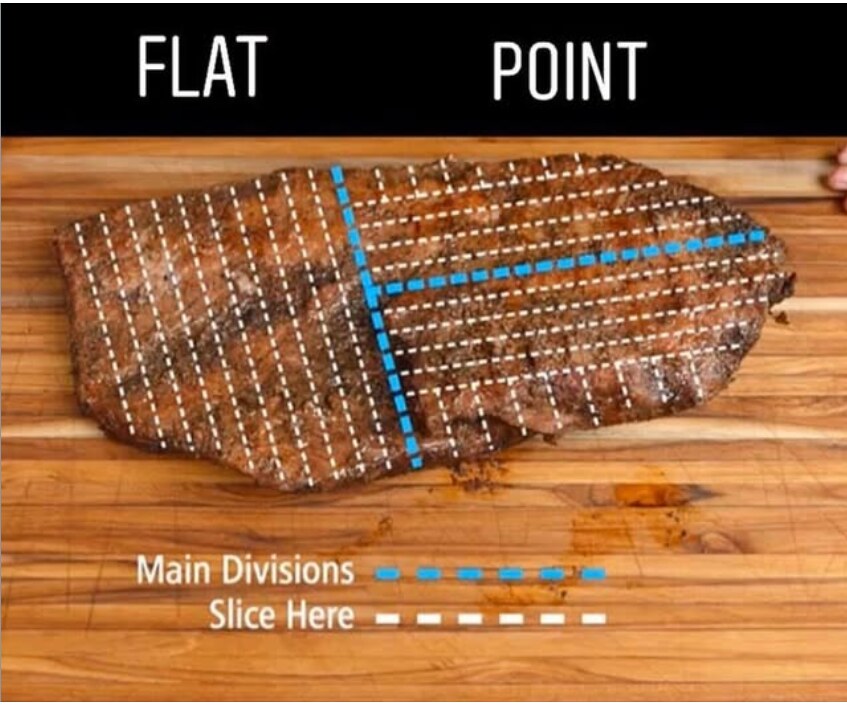
The flat is lean, so slice it thin. The point is the thicker end and is richer and fattier, so slice it about pencil-thick.
Slice only what you’re going to eat now. Leave the rest in nice-sized chunks to reheat and slice later.
If the brisket on your plate is stringy and tough—like meat spaghetti—it was probably sliced with the grain instead of across it.
The grain changes direction between the flat and point. Turn the point before slicing across the grain.
Tip 002 • Follow the Grain
How to Slice a Tri-Tip
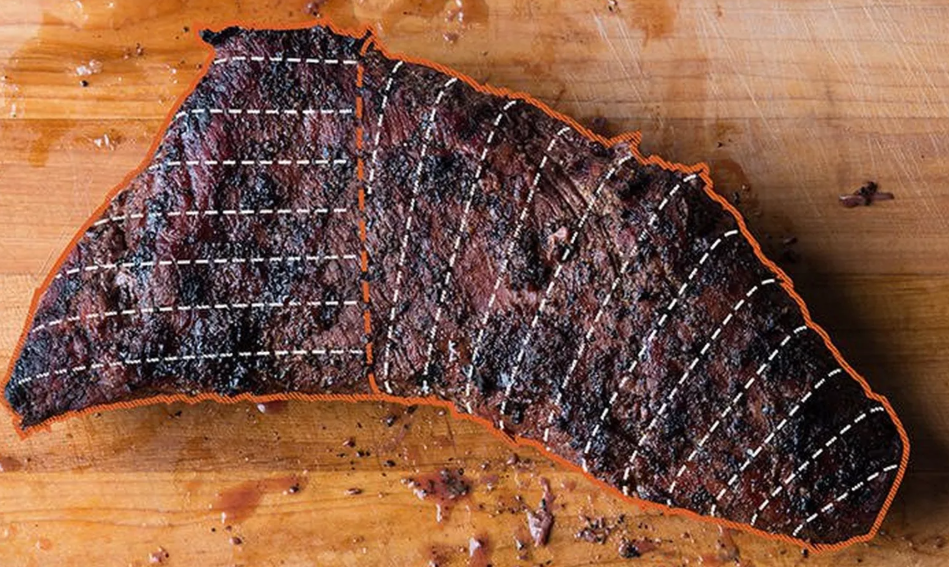
Tri-tip has two grain directions that meet near the bend in the roast. If you slice straight through the whole thing in one direction, part of it will be cut correctly and the rest will be chewy.
First, divide the tri-tip where the grain changes direction. Then rotate each section and slice it thinly across—not with—the grain.
Look at the grain before cooking and make a mental note of its direction. The finished crust can make those lines harder to see once the tri-tip comes off the pit.
Divide at the change in grain, then turn each section and slice across the grain.
Tip 003 • Gentle Heat Wins
Learn It. Live It. Love Sous Vide.
The best way to reheat almost any protein is to seal it in a bag—preferably vacuum-sealed—and submerge it in a sous vide water bath.
Barbecue is especially prone to drying out when reheated in an oven or on a grill because those methods use temperatures much higher than the temperature at which you intend to serve the meat.
Set your sous vide circulator to 150°F, then place the sealed barbecue in the water bath. Refrigerated barbecue will generally need about an hour, or until heated through. If it is frozen, allow two to three hours.
Remember: it’s already cooked. You’re simply bringing it gently back to serving temperature without drying it out.
Once you get comfortable using sous vide, it will likely become an essential part of your regular cooking routine—for barbecue and plenty of other foods.
Everything is already fully cooked. We’re simply reheating it gently while protecting its moisture and texture. Keep each item sealed in its vacuum bag when using sous vide, and follow the temperature and timing below.
Item
Recommended Method
Brisket
Sous vide at 150°F; 1 hour if thawed, minimum 3 hours if frozen.
Tri-tip
Sous vide to your preferred steak doneness; use 135°F for medium-rare.
Pork chops
Sous vide at 135°F; 30 minutes if thawed, minimum 1½ hours if frozen.
Pork belly
Wrap in foil and place in a 300°F oven for approximately 30 minutes.
Pork ribs
If foil-wrapped, place in a 300°F oven for 30–45 minutes. If vacuum-sealed, sous vide at 150°F for 1 hour.
Chicken halves
Sous vide at 150°F in the vacuum-sealed bag. They’re already cooked, so gentle reheating will keep them moist.
Wings
Place in a 300°F oven for approximately 30 minutes.
Turkey breast
Best served cold. If you prefer it warm, sous vide at 150°F for 1 hour if thawed or minimum 3 hours if frozen.
Beef ribs
Sous vide at 150°F in the vacuum-sealed bag; 1 hour if thawed, minimum 3 hours if frozen.
More Tips Are Coming
There is always something else to learn around the pit. Keep checking back—we’ll add more as we cook.